Solution patterns

Decisions, not dashboards

Representative cloud-risk scenarios showing how Cloudryption Solution Matching connects findings, attack paths, crown jewels, and remediation actions into risk-led decisions.

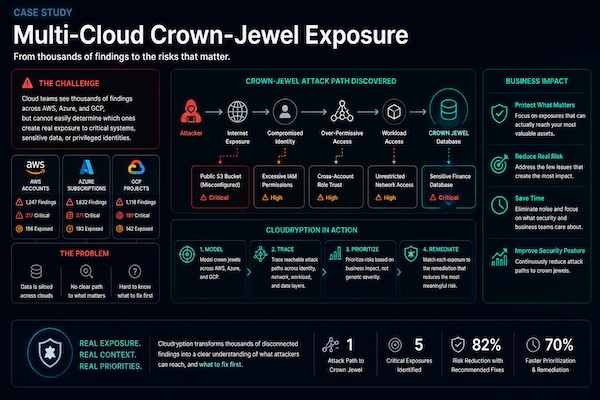
Multi-Cloud Crown-Jewel Exposure diagram

Multi-Cloud Crown-Jewel Exposure

Cloud teams often see thousands of findings across AWS, Azure, and GCP, but cannot easily determine which ones create real exposure to critical systems, sensitive data, or privileged identities.

Cloudryption helps teams:

  • Model crown jewels across cloud environments.
  • Trace reachable attack paths across identity, network, workload, and data layers.
  • Prioritize risks based on business impact, not generic severity.
  • Match each exposure to the remediation that reduces the most meaningful risk.
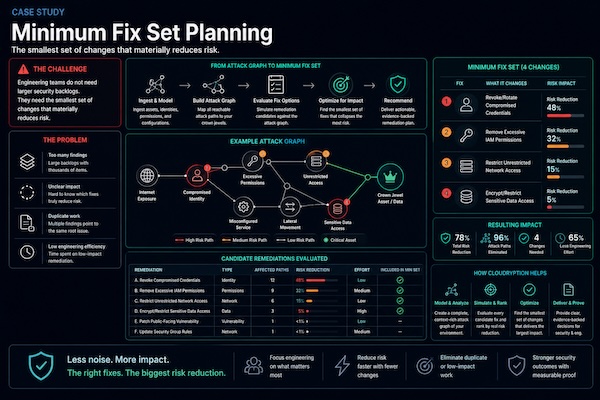
Minimum Fix Set Planning visualization

Minimum Fix Set Planning

Engineering teams do not need larger security backlogs. They need the smallest set of changes that materially reduces risk.

Cloudryption helps teams:

  • Evaluate candidate remediations against the current attack graph.
  • Identify which fixes collapse the largest blast radius.
  • Reduce duplicate or low-impact remediation work.
  • Produce evidence-backed remediation decisions for security and engineering teams.
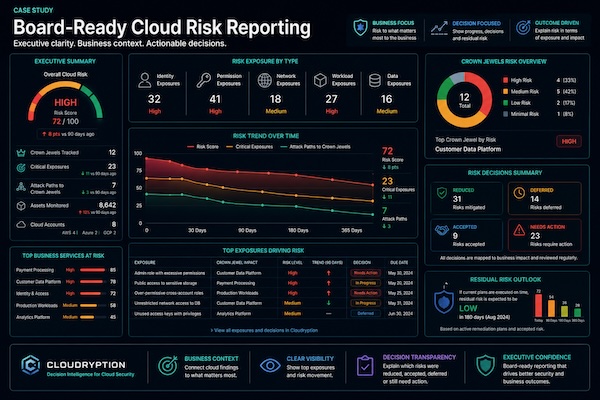
Board-Ready Cloud Risk Reporting dashboard

Board-Ready Cloud Risk Reporting

Security leaders need to explain cloud risk in terms of exposure, trends, decisions, and residual risk — not tool-specific alerts.

Cloudryption helps teams:

  • Connect technical findings to crown-jewel impact.
  • Show top exposures and decision status.
  • Track risk movement over 90, 180, and 365 days.
  • Explain which risks were reduced, accepted, deferred, or still require action.

Note: These are representative solution patterns. Validated customer outcomes and case studies will be published as deployments mature.